FRP vs Ductile Iron Manhole Cover: Practical Comparison & Buyer Guide
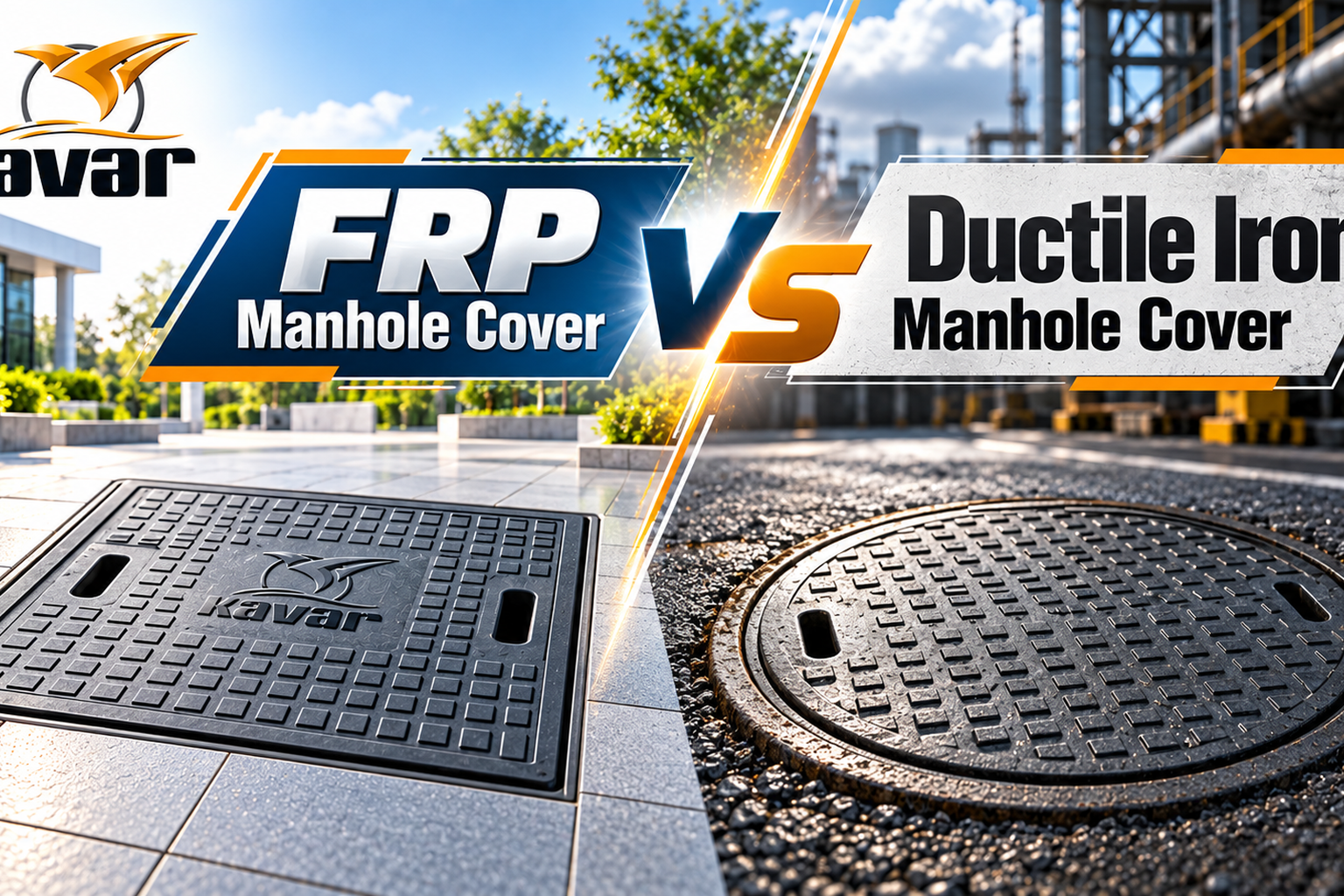
Comparing FRP and Ductile Iron Manhole Covers?
When comparing an FRP manhole cover and a ductile iron (DI) manhole cover, begin with the opening, traffic location and frame. KavarIndia discusses FRP composite access-cover options based on the site requirements buyers share. Here is what changes between these materials—and what does not.
- FRP: fibre reinforcement within a resin matrix
- Ductile iron: nodular-graphite cast iron, often protected by a coating
- Compare weight for the same opening and load requirement
- Check iron coatings and FRP resin compatibility
- Compare tested cover-and-frame assemblies, not materials alone
- Ask for dimensions, load evidence and installation details
Table of Contents
Two covers may fit the same chamber on paper but behave differently in service. In an FRP vs Ductile Iron Manhole Cover comparison, the useful questions are: How often will it be lifted? Do wheels cross it? Is the area wet or chemically aggressive? And does the frame properly support the lid? The answers matter more than a product label.
Quick answer: FRP (fibre-reinforced plastic) offers a non-rusting composite construction and can reduce handling weight. Ductile iron, a tough cast iron with nodular graphite, is widely used for traffic-rated access covers. Neither material guarantees a load class; choose a verified cover-and-frame assembly suited to the installation.
What Is the Difference Between FRP and Ductile Iron Manhole Covers?
FRP combines reinforcing fibres with a polymer resin. Ductile iron (also called spheroidal-graphite or SG iron) contains graphite in rounded nodules, helping it resist brittle fracture compared with conventional grey cast iron. These are different material systems, so their performance should be judged from the finished cover design.
FRP does not rust, although its resin and surface can be affected by specific chemicals, heat, sunlight or wear. Ductile iron can corrode if protective coatings are damaged; coating type and upkeep matter. For both, check the actual cover thickness, support arrangement, test documentation and frame, not a generic “heavy duty” claim.
Sticky Q&A: Is FRP better than ductile iron?
Answer: Not across every project. FRP is worth considering where rust resistance and frequent lifting matter. Ductile iron can be a practical fit for specified vehicular infrastructure. Match load class, clear opening, seating, environment and actual model documentation first; material comes next.
Where Are FRP and Ductile Iron Manhole Covers Used?
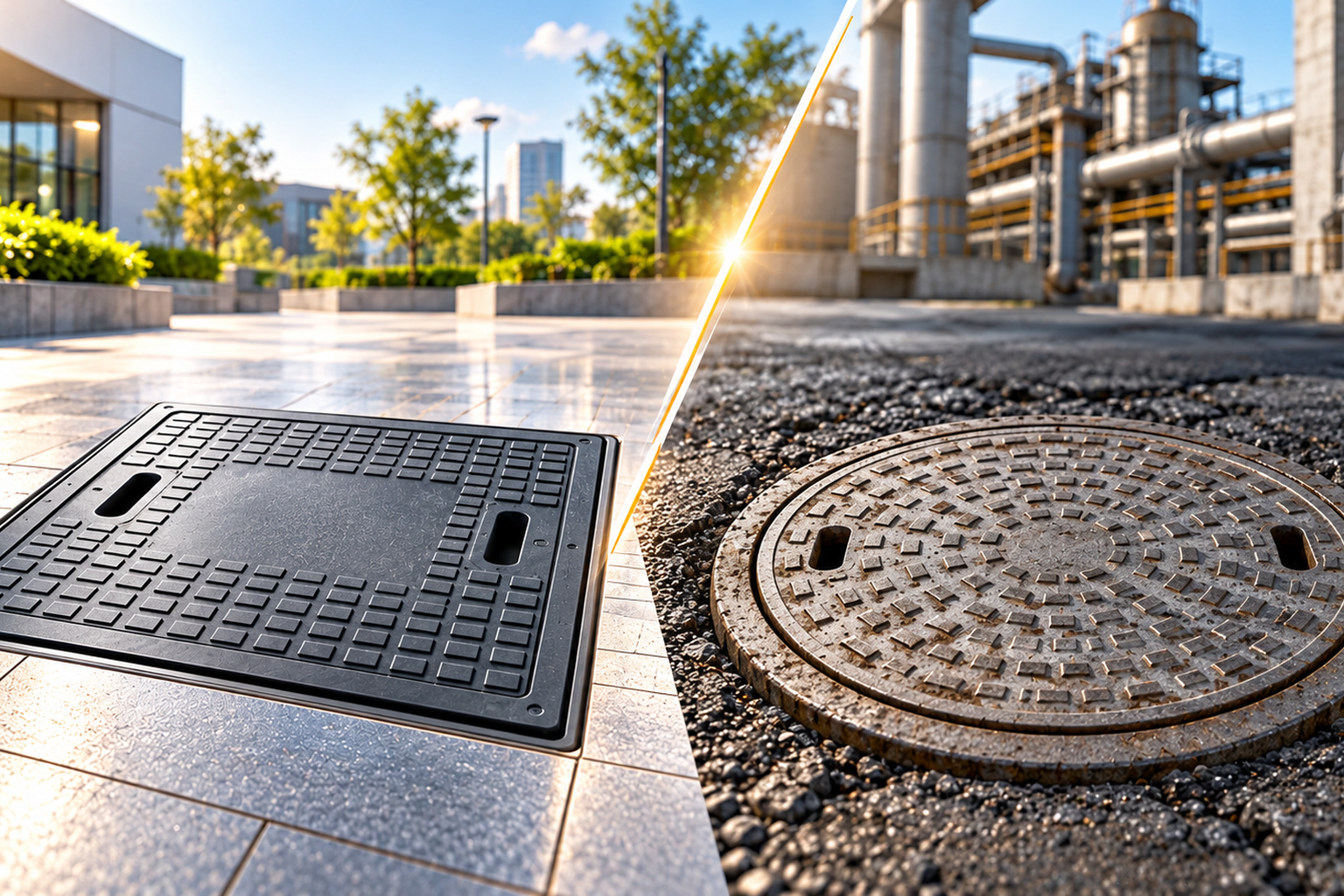
FRP and ductile iron manhole covers are used to close inspection and utility chambers. Typical locations include:
- Residential and Commercial Sites: walkways, landscaped utilities, parking bays and service corridors, with the appropriate load class for the actual traffic.
- Roads and Municipal Drainage: carriageways, shoulders and chamber access points; confirm traffic loading, locking needs and the road authority's specifications.
- Water and Wastewater Works: damp, potentially corrosive chambers; consider resin suitability for FRP and coating maintenance for ductile iron.
- Industrial Plants and Yards: forklift or truck routes, wash-down areas and inspection pits; confirm wheel loading and the supporting frame.
A manhole cover closes a chamber opening, while a gully grating allows surface water to enter. Do not confuse them. Also, a cover designed for a pedestrian area is not automatically suitable for a forklift path or road because it looks thick.
FRP vs Ductile Iron Manhole Cover: Key Differences
For a fair comparison, use the same clear opening and installation zone, and request data for the particular products. Broad material comparisons are helpful; they do not replace test reports and fitting drawings.
1. Load Capacity and Standards
Load class is a property of the tested assembly, not the raw material. In the EN 124 series, Part 2 covers cast-iron manhole tops and Part 5 covers eligible composite products. A15, B125, C250, D400, E600 and F900 are application classes, not material grades. For example, D400 is generally associated with road carriageways; exact location and local project rules determine the class. Confirm that the offered cover and frame have appropriate evidence for the claimed class. EN-GJS-500-7 is an example of a ductile-iron material grade under EN 1563, not a cover load rating.
2. Weight, Lifting and Installation
FRP is often attractive when access covers need repeated manual handling, while ductile iron lids can be heavier depending on the design. But “composite means lightweight” is not a lifting plan. Request the actual lid weight, frame weight and lifting method for the selected size and class. Measure the clear opening separately from the outer frame dimensions.
3. Corrosion, Moisture and Chemical Exposure
FRP contains no iron to rust. That helps in damp or salt-exposed sites, provided the resin suits the temperature and chemicals present. Ductile iron is metallic and typically relies on its coating and upkeep for corrosion control. Ask about coating repair, standing water and cleaning chemicals rather than assuming either material is immune to damage.
4. Impact, Surface Grip and Maintenance
Ductile iron has useful toughness, but impact, overload or poor seating can still damage a lid or frame. FRP can suffer cracking, delamination or surface wear when misused. Check anti-slip finish, stable seating, rocking/noise, lifting access and any locking arrangement. A cover that rocks in its frame will not improve just because the material is upgraded.
5. Initial Cost vs Long-Term Cost
Price comparison should include the complete assembly and site work: cover, frame, freight, lifting equipment, fitting, coating upkeep and access over time. FRP may reduce handling and rust-related maintenance in some locations; ductile iron may match existing traffic infrastructure more easily. Without comparable quotations and service conditions, neither has a proven lower lifetime cost.
KavarIndia: Practical FRP Selection Perspective
KavarIndia can review an FRP access-cover enquiry against the information supplied about the site. For replacement of a ductile iron lid, the critical details are the clear opening, frame profile, rebate, seating depth and required load class. Same outside dimensions are not proof that an FRP cover will work safely in an existing DI frame.
KavarIndia technical selection note: “The first question is not whether the cover is FRP or ductile iron. It is where the load goes when a wheel crosses the lid, and whether the frame supports it correctly.” Practical engineering guidance for this article; not a claimed product test result or a verified staff quotation.
- Opening and frame: provide clear dimensions, rebate depth, seating condition and details of any existing DI assembly.
- Location and loading: tell us whether it is a walkway, parking area, truck route, loading bay or service-yard access point.
- Documentation: ask for the declared class, applicable EN 124 part and supporting evidence for the offered configuration.
- Practical needs: note lifting frequency, corrosion exposure, grip, locks and any odor- or water-control requirements.
How to Choose Between FRP and Ductile Iron Covers
For an FRP vs Ductile Iron Manhole Cover enquiry, work through the following checks before placing an order:
- Start with traffic: identify pedestrian loads, parking use, road traffic or occasional forklifts and trucks.
- Measure both ways: record clear opening, frame outside size, rebate shape and depth—not just the old lid size.
- Match load class: use the project-specified class and ask for the tested model-and-frame combination.
- Inspect the frame: a worn or uneven DI frame may need replacement instead of a lid-only change.
- Plan for maintenance access: check lifting weight, handles, tools and safe opening procedures.
- Compare installed cost: include freight, labour, frame replacement, coating maintenance and future inspections.
Common Buying Mistakes to Avoid
Common mistakes include treating an EN-GJS iron grade as if it were an EN 124 load class, assuming a D400 marking applies to every size in a catalogue, choosing by lid dimensions without checking the frame, and using a generic breaking-load figure instead of the relevant test evidence. One easy miss: occasional delivery trucks crossing what was specified as a pedestrian-only area.
Buyer Specification Checklist
Send the clear opening, frame/rebate dimensions, frame material and condition, traffic type, required class, site exposure, lifting frequency, quantity and replacement photos. Request a dimensional drawing, actual product weights and relevant load-class evidence for the specific option offered.
Frequently Asked Questions
Conclusion & Call to Action
The FRP vs Ductile Iron Manhole Cover choice is a site-specific decision. FRP can help reduce rust concerns and improve handling; ductile iron offers a proven material route for many traffic-facing designs. The most useful buying decision is the one backed by a suitable load class, dependable frame fit, manageable maintenance and realistic installed cost.
Discuss an FRP Cover Option with KavarIndia
Share the chamber and frame dimensions, traffic conditions, required load class, exposure details and quantity with KavarIndia. Ask about the proposed FRP assembly and its documented suitability before replacing a ductile iron cover.
Enquire Now
KavarIndia provides FRP composite access-cover options for utility and infrastructure enquiries. Comparing FRP vs Ductile Iron Manhole Cover products? Share the opening, frame details, location and required load class so the right FRP option can be discussed.