FRP vs Concrete Manhole Cover: Practical Comparison & Buyer Guide
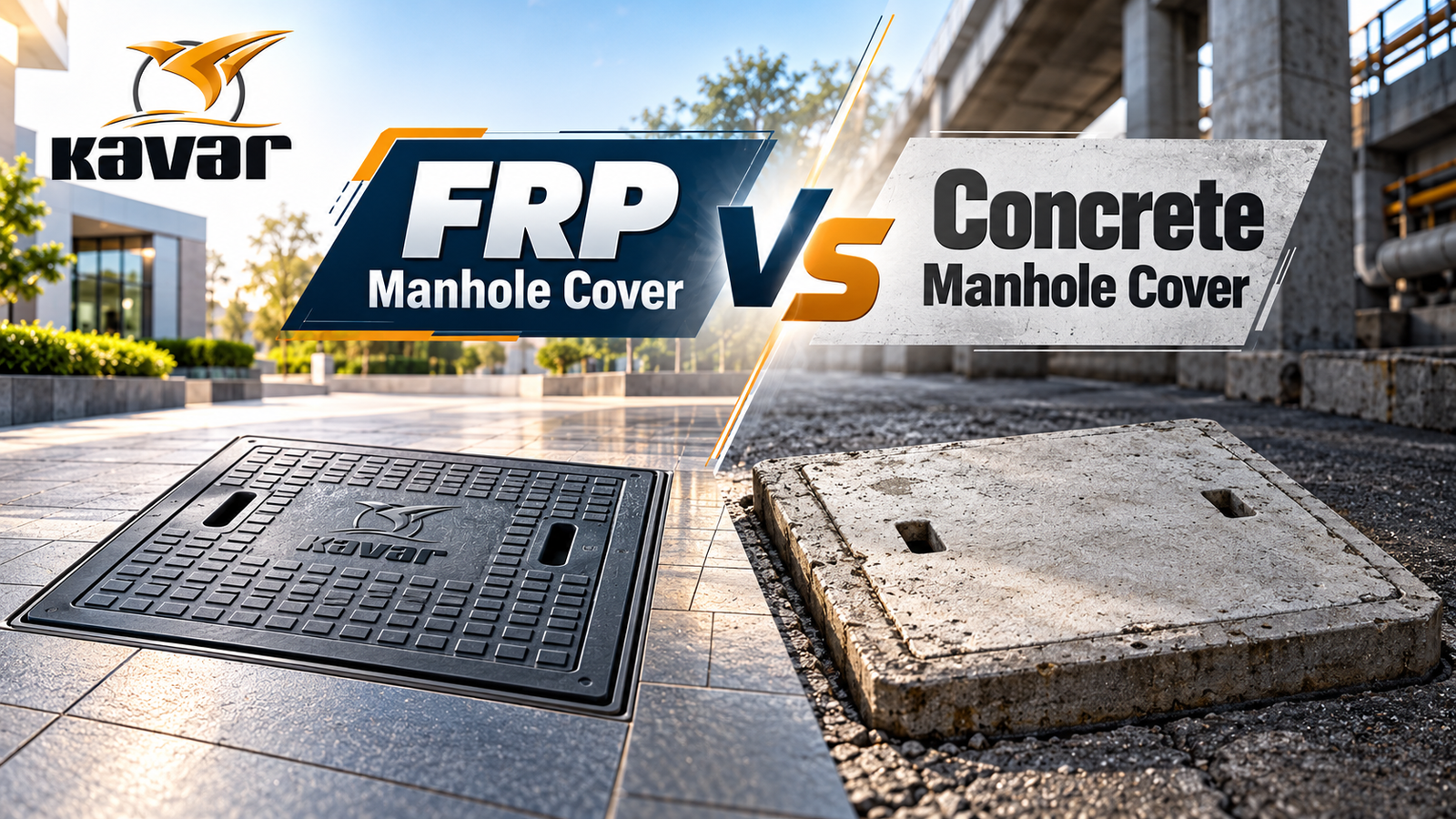
Comparing FRP and Concrete Manhole Covers?
When choosing between an FRP manhole cover and a concrete manhole cover, start with the intended traffic load, clear opening and frame support—not just the material. KavarIndia supplies FRP composite access covers and can discuss selection details for your project. This guide explains where FRP may be helpful, where reinforced concrete still makes sense and what to verify before ordering.
- FRP: fibre reinforcement within a resin matrix
- Concrete: cement-based material, commonly reinforced with steel
- Compare weight for the same opening and load requirement
- Check corrosion, moisture and environmental exposure
- Compare tested cover-and-frame assemblies, not materials alone
- Ask for dimensions, load evidence and installation details
Table of Contents
Choosing a manhole cover seems straightforward until two options have the same opening size but different weight, support and long-term upkeep. The FRP vs Concrete Manhole Cover decision comes down to the actual job: vehicle movement, access frequency, exposure to water or chemicals, and what the supporting frame can carry. Neither material is automatically suitable for every location.
Quick answer: FRP (fibre-reinforced plastic) covers can offer easier handling and resistance to rust, while reinforced concrete covers can suit installations designed around their mass and structural form. The safer choice is the correctly rated, properly supported cover-and-frame assembly for the site—not simply the lightest or cheapest lid.
What Is the Difference Between FRP and Concrete Manhole Covers?
FRP has no steel reinforcement to rust, which can help in wet or corrosive settings. Concrete itself does not rust, but embedded steel may corrode if cracks, poor cover or exposure allow moisture and salts to reach it. FRP resin compatibility with solvents, fuels, temperature and UV exposure must also be checked; it is not universally chemical-proof.
Both materials come in different designs and ratings. An FRP cover's fibre layout, resin, thickness and frame matter. A concrete cover's reinforcement, thickness, manufacturing quality and support matter. Do not infer load capacity from material type, nominal dimensions or a seller's “heavy duty” label.
Sticky Q&A: Which manhole cover should you choose?
Answer: compare the same clear opening, installation zone and required load class. Then review handling weight, corrosion exposure, lifting access, frame seating, installation method and evidence for the specific model. Comparing only the price per cover misses the important bits.
Where Are FRP and Concrete Manhole Covers Used?
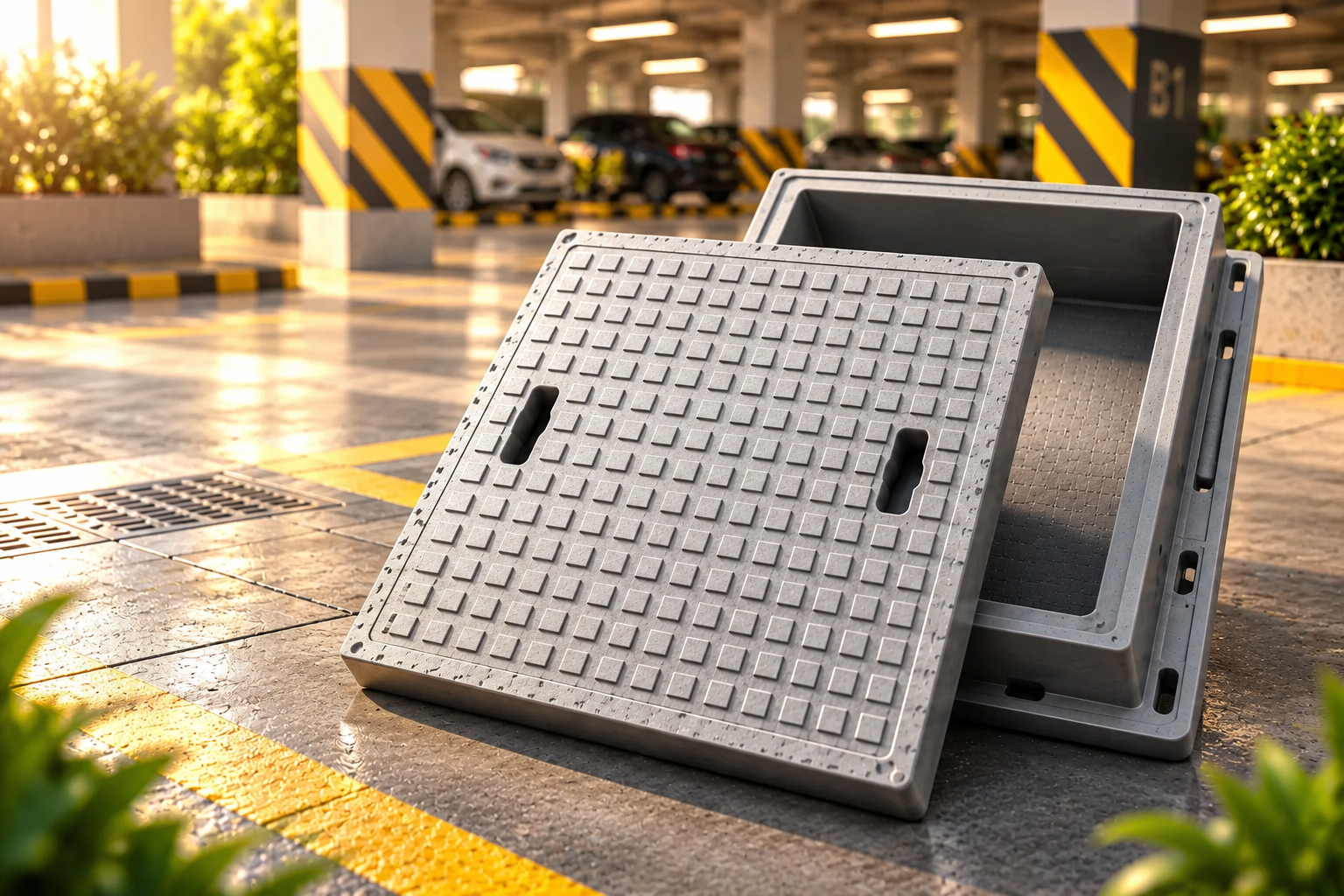
FRP and concrete manhole covers are considered for similar access openings, but the decision can differ by location:
- Residential and Commercial Buildings: basements, utility rooms, walkways and parking areas, with rating chosen by actual wheel paths.
- Municipal and Road Infrastructure: drainage and inspection chambers where the local authority or consultant specifies the load class.
- Water and Wastewater Utilities: chambers where damp conditions, access frequency and chemical exposure affect material selection.
- Factories and Service Yards: vehicle access areas, but only after checking axle loads, lifting methods and project requirements.
A manhole cover closes an access chamber; a drain grating admits water. These are different products. Also, a concrete cover designed for a stationary utility chamber should not be assumed suitable for vehicle wheel loads without appropriate rating and installation details.
FRP vs Concrete Manhole Cover: Key Differences
Below is a practical, like-for-like comparison. Actual performance depends on the model, dimensions, design, specified load class and installation—not just the raw material.
1. Load Capacity and Standards
Load capacity cannot be assigned by material alone. If an EN 124 class is specified, check the exact cover-and-frame assembly and its evidence. EN 124-5 concerns eligible composite designs; EN 124-4 concerns precast steel-reinforced concrete designs. Where applicable, B125 covers certain pedestrian/car-park locations, while D400 is associated with road carriageways and vehicle parking areas. The engineer must confirm the correct class for the actual installation.
2. Weight, Lifting and Installation
FRP covers may be easier to lift for repeated chamber access, depending on size and design; concrete covers can be substantially heavier and may need more people or lifting equipment. Ask for actual unit weight rather than assuming that every composite cover is lighter than every concrete one. Also measure the clear opening, seat and frame separately.
3. Corrosion, Moisture and Chemical Exposure
FRP does not rust like ferrous metal, which can be useful in basements, wash-down zones and outdoor parking exposed to rainwater. Chemical resistance, however, depends on the resin system and exposure, so unusual fuels, solvents or industrial chemicals should be disclosed during selection.
4. Cracking, Surface Grip and Service Conditions
The lid and its surrounding surface need suitable grip, flush installation and stable support. Ask about tested slip resistance where required. Reinforced concrete can crack or chip under impact or poor support; composites can also crack, delaminate or lose performance if overloaded or damaged. Neither material is maintenance-free.
5. Initial Cost vs Long-Term Cost
Consider the full cost: product, frame, transport, labour, lifting tools, repair and expected inspection frequency. A lower purchase price does not always mean lower installed or lifetime cost. Concrete may be practical for some fixed or established chamber designs; FRP may be attractive where frequent opening and corrosion resistance matter.
KavarIndia: Practical FRP Selection Perspective
KavarIndia can discuss FRP composite access-cover options against the project details supplied by the buyer. A useful enquiry includes the current concrete-cover dimensions (if replacing one), the frame/rebate condition, traffic type and the required load class. Replacing a concrete cover with FRP is not automatically a drop-in swap.
KavarIndia technical team perspective: “When a buyer asks whether FRP is better than concrete, we would first check the opening, wheel load and frame. A cover that fits the hole but sits badly on the rebate is not a good selection, whatever material it uses.” This is practical selection guidance, not a product test claim.
- Opening and frame: clear size, rebate depth, condition of seating and replacement constraints.
- Location and loading: pedestrian area, parking bay, carriageway or service-vehicle route.
- Documentation: test/load-class information for the exact proposed cover and frame.
- Practical needs: frequency of lifting, surface grip, locking and exposure conditions.
How to Choose Between FRP and Concrete Covers
For an FRP vs Concrete Manhole Cover enquiry, use this checklist before comparing quotations:
- Start with Traffic: confirm the heaviest expected vehicle and whether wheels pass over the lid.
- Measure Both Ways: clear opening is not the same as cover outside dimensions; inspect the rebate.
- Match Load Class: request the engineer-specified class and evidence for the exact model.
- Inspect the Frame: do not place a new lid on damaged, uneven or incompatible seating.
- Consider Day-to-Day Access: weight matters if the cover is lifted for inspections each month.
- Compare Installed Cost: include lifting, transport, installation and maintenance—not just the unit quotation.
Common Buying Mistakes to Avoid
Common mistakes include comparing unequal load classes, measuring the old lid instead of the clear opening, overlooking frame condition and assuming FRP is always stronger or concrete is always more durable. Another issue is using a test-load marketing figure without checking the referenced standard and the model tested. These mistakes are avoidable with a site photo, drawing and model-specific data.
Buyer Specification Checklist
Share the clear opening, cover shape, frame/rebate dimensions, seating depth, load class, vehicle type, exposure conditions, expected access frequency, quantity and whether this is a replacement. Request the exact weight and documentation for the offered model. If retaining an old concrete frame, confirm that the proposed FRP lid is compatible with it.
Frequently Asked Questions
Conclusion & Call to Action
The FRP vs Concrete Manhole Cover choice is not about one material winning every comparison. FRP may help with handling and corrosion resistance; reinforced concrete can remain suitable where its mass, form and installation are properly designed for the job. Prioritise verified load performance, correct fit, safe access and realistic installed cost.
Discuss an FRP Alternative with KavarIndia
Share your chamber dimensions, the frame/rebate photo, traffic conditions, required load class and quantity with KavarIndia. Ask about the exact FRP cover design and documented suitability before planning a switch from concrete.
Enquire Now
KavarIndia supplies FRP composite access solutions for infrastructure and utility projects. Comparing FRP vs Concrete Manhole Cover options? Share the opening size, frame details, traffic and project load requirement to discuss an appropriate FRP option.