FRP Manhole Cover Size Guide: Dimensions, Load Classes & Buyer Checklist
Choose the Right FRP Manhole Cover Size
A size written on a quotation is not always the size of the opening in the ground. KavarIndia recommends checking the clear opening, cover size and frame dimensions separately, along with traffic loading and installation conditions.
- Start with the clear opening, not a catalogue label
- Check round or square chamber geometry
- Measure the existing lid and frame separately
- Record rebate, seating width and frame depth
- Select load class from the actual traffic zone
- Request a drawing for the specific assembly
Table of Contents
A manhole cover can be marked “600 × 600 mm”, yet still fail to fit a 600 mm opening. The problem is usually not the material. It is that the quote, old lid and site drawing describe different dimensions. This FRP Manhole Cover Size Guide separates those measurements so buyers can specify a usable cover and frame.
Quick answer: Measure the clear opening first, then the cover and frame dimensions, rebate depth, shape and intended traffic. A nominal size by itself does not confirm frame compatibility or load capacity. Request the dimensional drawing and relevant load-class evidence for the exact assembly.
What Does FRP Manhole Cover Size Actually Mean?
An FRP (fibre-reinforced polymer) manhole cover is a composite lid used over an inspection, drainage or utility chamber. “Size” can mean the unobstructed clear opening, the removable lid dimensions or the full frame footprint. Those three measurements should not be treated as interchangeable.
For example, a quote for “600 × 600 mm” might refer to a clear-access dimension on one drawing and a lid dimension on another. Measure and label both width and length in millimetres; for round covers, use diameter. An older frame may be out of square or have a damaged bearing ledge.
Sticky Q&A: Is nominal size the clear opening?
Answer: There is no universal conversion. Ask whether the stated size refers to the clear opening, lid outside size or outer frame. Confirm the rebate and seating details with a drawing before ordering.
Common FRP Manhole Cover Sizes and Applications
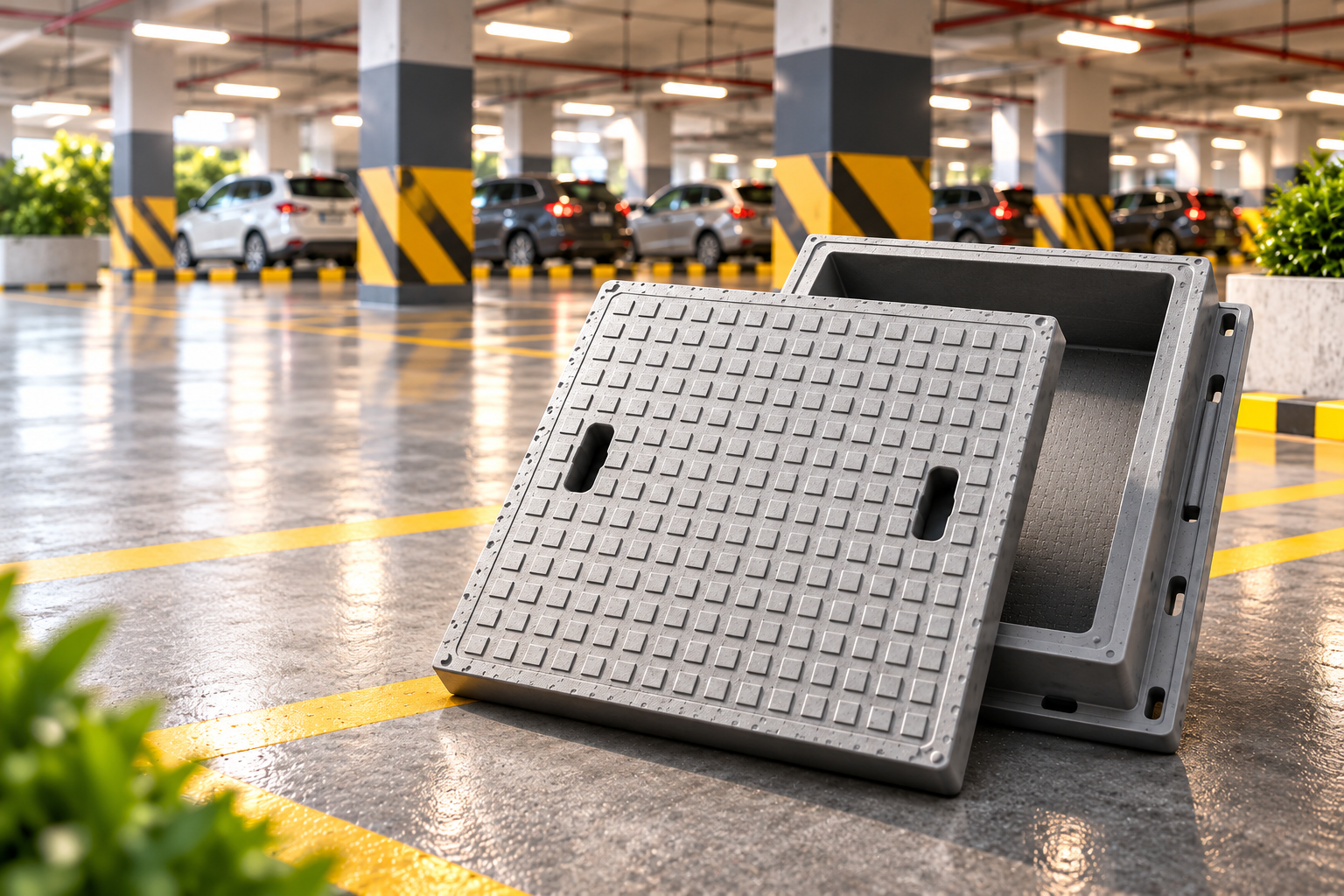
FRP covers are considered for inspection chambers at housing sites, commercial buildings, walkways, industrial utilities, wastewater areas and suitable parking or traffic locations. Size and loading are separate choices: a wide cover is not automatically heavy-duty.
- Residential and commercial walkways: measure inspection pits and choose for pedestrian use and any service vehicles.
- Parking and access roads: confirm whether cars, trucks or maintenance vehicles can pass over the chamber.
- Water, drainage and wastewater: check clear access for maintenance plus moisture and chemical exposure.
- Industrial and service yards: establish actual wheel loads and any forklift or delivery-truck routes.
A frequent site problem is the “occasional” vehicle that nobody mentioned during purchase—a delivery van, tanker or forklift. Tell the supplier what can actually cross the cover, not only what the area is called.
How to Measure FRP Manhole Covers and Check Load Class
Use the following dimensional and load checks for a new installation or replacement. Sizes discussed below are illustrative buyer enquiries, not a published KavarIndia size range or a promise of product availability.
1. Common Nominal Sizes: Square and Round
Commonly requested nominal square sizes include 300 × 300, 450 × 450, 600 × 600 and 900 × 900 mm. Round projects may ask for 450 or 600 mm openings. Actual lid and frame outside dimensions vary by design; do not cut an opening from these examples without a manufacturer drawing.
2. Clear Opening vs Cover vs Frame
Clear opening is the usable internal space after the frame is fitted. Lid size is the removable cover’s outer measurement. Frame outside size is the space occupied by the full frame. Rebate depth and bearing width determine how the lid rests and transfers load. Record all five when replacing an existing unit.
3. How to Measure the Existing Opening
For a square opening, measure clear width and length on more than one side, then measure diagonals if the corners may be out of square. For a round opening, measure the internal diameter in two directions. Take a photo with a tape measure and note any broken concrete or corroded seating.
4. Size Does Not Determine Load Class
A15, B125, C250 and D400 are EN 124 load classes associated with different installation areas, not millimetre sizes. A15 concerns pedestrian/cycle-only locations; B125 covers defined pedestrian and parking areas; C250 relates to kerbside channels; D400 generally covers carriageways. The correct class depends on the site specification and approved assembly. EN 124-5 applies to specified composite products within its defined scope, used with EN 124-1; it does not cover every possible hand-laid FRP product.
5. Fit, Seating and Installation Checks
Before installation, compare the actual frame footprint with the civil opening, check an even bearing surface and follow the supplier’s fixing details. A mismatched lid can rock, jam or concentrate load at a corner. Do not assume an existing frame can safely accept another brand’s lid.
KavarIndia: What to Share for a Size Enquiry
KavarIndia enquiries are easier to assess when drawings and photos show the chamber as it exists, not only the approximate size written on a purchase request. Include the clear opening, lid size, frame footprint, seating profile, site use and required load class.
Technical selection note for KavarIndia: “A 600 mm opening and a 600 mm lid are two different measurements. We would check the frame seat and traffic before calling either one the right size.” This is suggested practical wording for the guide, not a verified quotation from a named employee or a test claim.
- Clear opening: provide finished internal dimensions, not just the nominal label.
- Cover and frame: record lid outside dimensions, frame footprint, seat width and depth.
- Traffic: state pedestrian, parking, road, forklift or service-vehicle use.
- Documents: request a model drawing, appropriate class evidence and installation guidance.
How to Choose the Correct FRP Manhole Cover Size
Use a short check before issuing the purchase order. A little extra measurement on site usually costs less than finding out the lid has no proper bearing after delivery.
- Measure the clear opening after removing loose debris and checking safe access.
- Record lid width/length or diameter and the entire frame footprint separately.
- Check seating ledge, rebate depth, damage and the opening’s shape.
- Identify traffic and the engineer-specified load class before choosing.
- Compare the offered cover-and-frame drawing to actual site dimensions.
- Confirm the lifting method, fitting details and any locking requirements.
Common Size-Selection Mistakes
Common mistakes are ordering against the old cover’s outside size alone; treating nominal size as clear opening; ignoring a damaged frame; assuming a square size suits a round chamber; selecting a load class from thickness; and missing occasional trucks or forklifts. Another easy miss is forgetting the space needed to lift the lid safely.
Buyer Specification Checklist
Share measurements in mm and identify which dimensions each number represents. Add location photos, required load class, traffic type, frame condition, quantity and whether you need a complete frame-and-cover set. Request a model-specific drawing, weight, fitting instructions and supporting class documentation.
Frequently Asked Questions
Conclusion: Specify the Opening, Frame and Load Together
The useful outcome of an FRP Manhole Cover Size Guide is not one universal size chart. It is a complete set of measurements that lets the right assembly be checked. Begin with clear opening, shape and frame seating; then verify the installation load class and the particular product drawing. If the existing frame is uneven or damaged, include that in the enquiry rather than ordering a lid by memory.
Share Your Dimensions with KavarIndia
Send the clear opening, cover and frame dimensions, two or three site photos, traffic type, required load class and quantity. KavarIndia can use those details to discuss a suitable FRP access-cover option and what needs verifying before purchase.
Enquire Now
KavarIndia discusses FRP composite access-cover selections for real site conditions. For a size enquiry, share the clear opening, frame profile, required load class, location photos and quantity so the proposed dimensions can be checked.