Best Kitchen Sink for Indian Kitchen: A Practical Buying Guide
Choosing a Kitchen Sink for Everyday Indian Cooking?
The best kitchen sink for Indian kitchen use is the one that fits your largest utensils, cabinet and cleaning routine. A neat-looking sink can be awkward if a kadai cannot lie flat or the trap clashes with a drawer. Start with practical measurements, then compare materials and finishes.
- Compare quartz-composite and stainless steel
- Think about large kadais and pressure cookers
- Measure actual bowl width, depth and cabinet clearance
- Choose single or double bowl for your routine
- Check top-mount or undermount compatibility
- Plan faucet reach, drain kit and maintenance
Table of Contents
A kitchen sink gets tested more than almost any showroom photo suggests. Think oily kadais after dinner, a pressure cooker lid, vegetable peels and the morning rush. You need room to move, a faucet that reaches and a surface you can keep clean without fuss.
Quick answer: The best kitchen sink for Indian kitchen requirements usually has enough uninterrupted space for large utensils, comfortable bowl depth, an installation that fits the base cabinet, and a material whose care you can manage. A deep single bowl often suits large vessels; a double bowl helps if separate washing and rinsing matter more.
What Makes a Kitchen Sink Practical for Indian Homes?
A kitchen sink is the fixed basin used for washing utensils, food items and hands, connected to a faucet and a drain. In an Indian household, useful capacity matters more than the outside dimensions printed in an advert. Check the inside width and length of the basin, its depth, corner shape and the room around the tap.
There is no single sink that suits every kitchen. A compact flat may need a straightforward single bowl. A larger family may prefer two basins for soaking and rinsing. Material and mounting style also change upkeep, sound, edge cleaning and installation requirements. Start with daily habits rather than a fashionable colour.
Sticky Q&A: Which kitchen sink works for Indian cooking?
Answer: For frequent washing of large kadais and pressure cookers, prioritise one roomy, reasonably deep basin. If you wash and rinse at the same time, consider two bowls—but only if the larger bowl still accepts your regular cookware. The right choice follows your utensils, not a fixed size or a brand claim.
Where Does Each Kitchen Sink Layout Work Well?
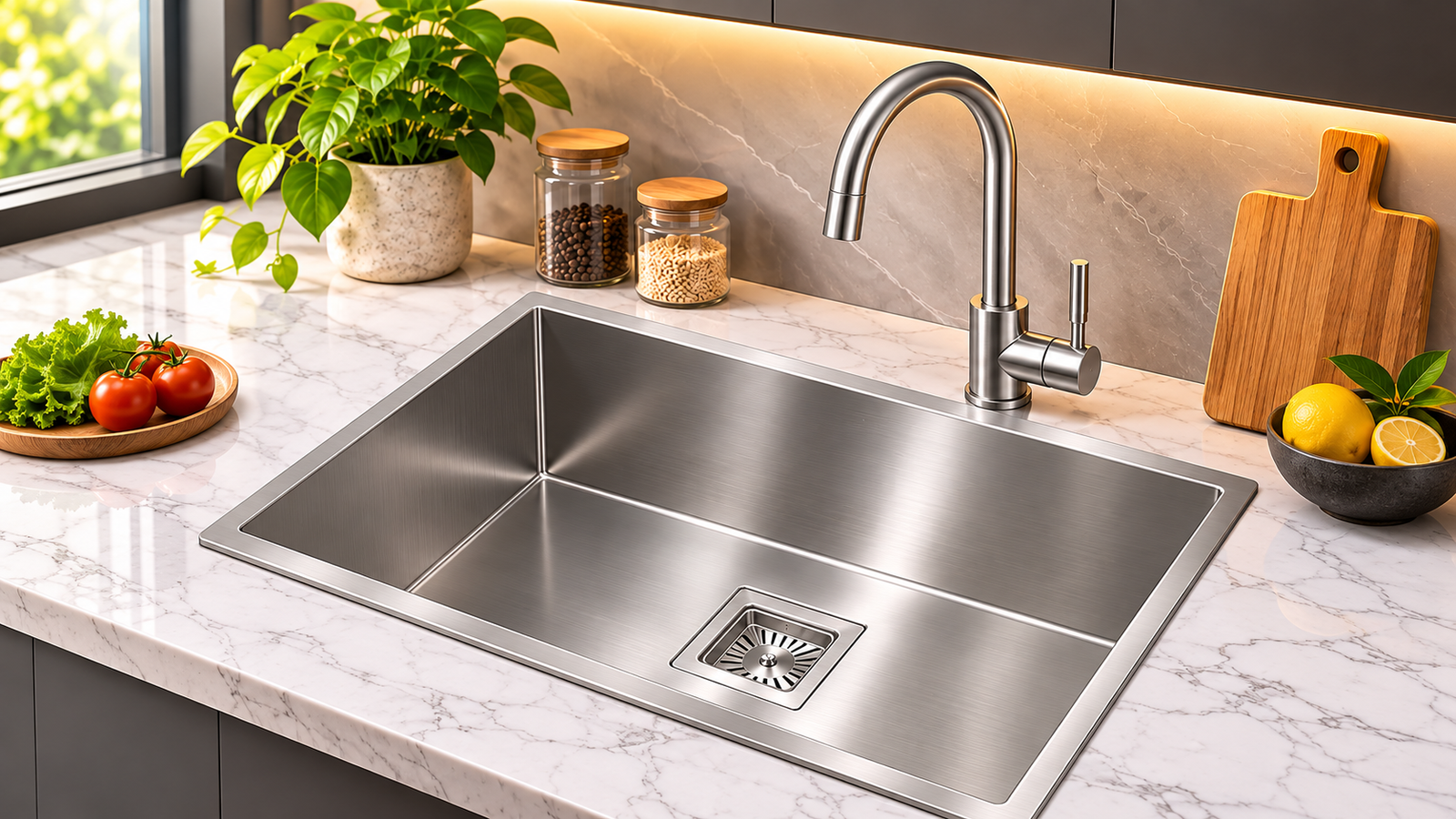
The choice between single bowl and double bowl kitchen sinks is really a choice about how you work. Both can suit modular or conventional kitchens if the countertop and plumbing support them:
- Compact Apartments: a single large bowl often keeps enough room for a cooker and everyday plates.
- Family Kitchens: a double bowl can keep rinsing separate from a pile of utensils, if both bowls are usefully sized.
- Modular Kitchens: match sink and trap to cabinet width, drawer hardware and purifier connections.
- Utility Areas: allow for frequent heavy washing, drainage access and a durable, easy-to-clean surface.
For a double bowl, remember that the divider takes up usable space and each basin generally needs a waste outlet. For a single bowl, check where dishes will drain and whether a worktop drainer or basket is useful. A high-arc faucet may help with pots, but spout reach and splash also matter.
Kitchen Sink Specifications That Actually Matter
Before comparing prices, request a dimensioned drawing of the exact model. The outside measurements, clear bowl measurements, corner radius, drain position and mounting method tell you more than the product image.
1. Stainless Steel vs Quartz-Composite Sinks
Stainless steel: generally lighter and familiar for everyday washing. Ask the seller to confirm the actual stainless-steel grade (such as 304, where specified), sheet thickness, finish and noise-control features, rather than assuming every steel sink is identical. Quartz composite: mineral particles bound with resin, usually selected for its stone-like appearance and feel. Its formulation, heat tolerance and stain resistance are model-specific. Neither material is maintenance-free.
2. Bowl Size, Depth and Cabinet Clearance
Check the overall size, internal bowl width and depth, cabinet clear width and countertop depth. Large vessels need enough flat working space; deeper is not automatically more comfortable if the counter is already high. Leave room below for the trap, water purifier, pull-out bin, drawer and dishwasher hose. Never cut the slab using an approximate online size.
3. Top-Mount or Undermount Installation
A top-mount sink rests on the countertop rim, while an undermount sink is fixed below an appropriate countertop. Installation depends on the approved design, supporting hardware and worktop material. Get the model-specific cut-out and fitting instructions before fabrication. An undermount look is not worth a weak support arrangement.
4. Finish, Cleaning and Everyday Wear
Food residues matter in real kitchens: tea, turmeric, oil and mineral-rich water should not sit around for long. For regular cleaning, mild detergent and a soft sponge followed by rinsing and drying are sensible starting points. Follow material-specific directions; abrasive pads can alter finishes, and hot cookware should not be placed directly on a composite sink unless its manufacturer permits it. Ask about care before ordering dark or textured finishes.
5. Drain Outlets, Faucet Reach and Full Cost
Check outlet size, included waste coupling, trap clearance, overflow provision if present and compatibility with appliance connections. A double bowl commonly needs two outlets joined into an appropriate waste system. Budget for the faucet, waste kit, countertop cutting, sealant, brackets and fitting labour. Two models with the same advertised sink price may have very different installation costs.
How KavarIndia Can Help You Compare Kitchen Sinks
KavarIndia is a relevant point of enquiry for quartz kitchen sink options. Ask about current models, finishes, overall and internal bowl sizes, suitable fitting method and available accessories. For stainless-steel alternatives, compare any supplier’s declared material specification rather than assuming KavarIndia stocks a particular grade or design. A kitchen drawing helps make the discussion practical.
Suggested technical-team wording for KavarIndia (requires approval; not a verified staff quotation): “Before choosing the sink colour, place your biggest kadai on the kitchen plan. If the bowl is too small for that, it will bother you every day.” This is editorial draft language, not a claim that a KavarIndia employee said it.
- Available space: clear cabinet width, countertop thickness and cut-out clearance.
- Daily vessels: your largest kadai, stockpot and pressure cooker.
- Product drawing: confirmed bowl measurements, mounting type and care instructions.
- Installation: faucet reach, waste fittings, trap location and support requirements.
How to Choose a Kitchen Sink for an Indian Kitchen
Use this quick checklist when comparing the best kitchen sink for Indian kitchen needs. A few minutes with a tape measure can prevent a costly countertop change:
- Measure the Cabinet: check clear inner width, counter depth and under-sink obstructions.
- Try the Largest Utensil: compare its dimensions with the actual usable bowl, not the outer frame.
- Choose the Bowl Layout: single for uninterrupted space; double for separate tasks if room permits.
- Confirm the Material: obtain declared specifications for steel or quartz composite and the care guide.
- Check Fittings: verify mounting, tap reach, drain outlets, waste kit and fabricator instructions.
- Compare the Full Quote: include accessories, countertop work, installation and delivery.
Common Kitchen Sink Buying Mistakes
One mistake is buying by outer width alone. A wide rim and rounded corners can leave less bowl space than expected. Others: ordering an undermount sink without checking the slab, ignoring the trap behind a pull-out drawer, assuming “stainless steel” tells you the grade, relying on a photo for the cut-out, or choosing two small bowls when most washing involves one large kadai. Even tap placement is worth checking before the hole is drilled.
What to Share When You Enquire
Send your cabinet’s clear inside width, countertop depth and material, available cut-out area, largest utensil size, preferred single or double bowl, fitting method, tap position, drain arrangement, desired finish and delivery city. Ask for the exact product drawing, declared material details, accessory list, care instructions and current availability.
Frequently Asked Questions About Kitchen Sinks
Conclusion: Choose for Your Cooking Routine, Not Just the Look
The best kitchen sink for Indian kitchen use is one that handles the utensils you actually wash and fits the space you actually have. Compare quartz composite and stainless steel thoughtfully, check real bowl dimensions, confirm the mounting and waste connections, and read the care instructions. A good-looking sink is even better when it makes everyday clean-up easier.
Discuss Kitchen Sink Options with KavarIndia
Renovating a modular kitchen or fitting out a new one? Share your layout and cabinet measurements with KavarIndia to discuss available quartz sink options, model-specific drawings, finishes and accessories. Check the technical details before placing an order.
Enquire Now
BEST KITCHEN SINK FOR INDIAN KITCHEN: Buying Guide
06 Nov, 2026KavarIndia can help you discuss quartz kitchen sink options for an Indian kitchen. Share your cabinet size, largest utensil, preferred bowl layout and installation plan, then request model-specific dimensions, available finishes and fitting information.